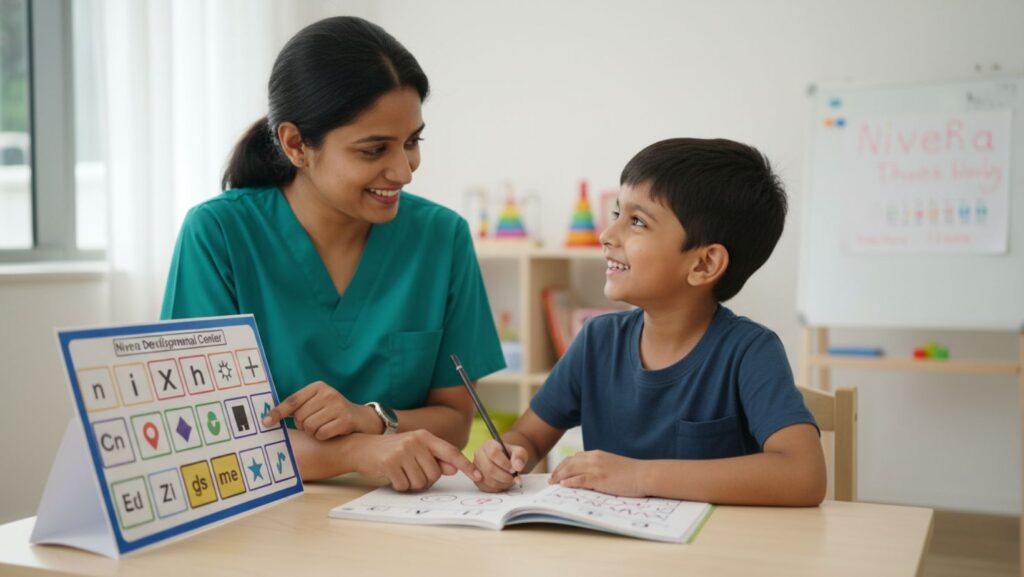
Nivera Child Developmental Center in Trivandrum offers structured, goal-oriented Education Therapy for children who struggle with learning, academics, attention, memory, and classroom performance. Education therapy bridges the gap between traditional teaching and a child’s actual learning capacity.
Many children fail to keep up in school not because they lack intelligence, but because their brain processes information differently. Standard classroom teaching does not adapt to these differences. Education therapy focuses on how a child learns, not just what they are taught.
At Nivera, education therapy is delivered through individualized instruction, evidence-based strategies, and continuous progress tracking, ensuring children build strong academic foundations and learning confidence.
Education therapy is a specialized intervention that helps children develop learning skills, academic abilities, and study strategies tailored to their cognitive profile. It addresses difficulties in reading, writing, mathematics, attention, memory, comprehension, and executive functioning.
Unlike tutoring, education therapy does not repeat school lessons blindly. It identifies the root cause of learning difficulty and fixes the underlying skill gaps that block progress.

➡️ Slow reading or poor comprehension
➡️ Difficulty writing sentences or paragraphs
➡️ Poor spelling
➡️ Struggles with maths concepts
➡️ Inconsistent exam performance
➡️ ADHD
➡️ Poor focus and concentration
➡️ Slow information processing
➡️ Difficulty following instructions
➡️ Poor task completion
➡️ Autism Spectrum Disorder
➡️ Learning Disability
➡️ Developmental Delay
➡️ Slow Learners
➡️ Executive function difficulties
➡️ Falling behind classmates
➡️ Low confidence in learning
➡️ Homework stress
➡️ Avoidance of studies
➡️ Poor academic independence
If schoolwork is becoming a daily struggle, education therapy is not optional — it is necessary.

Each child receives a personalised education plan based on learning assessment, cognitive strengths, and weaknesses.
We build core skills such as attention, memory, comprehension, reasoning, and organization — which automatically improves academics.
We use structured and proven techniques including:
➡️ Multisensory learning
➡️ Phonics-based reading strategies
➡️ Visual-auditory integration
➡️ Task analysis
➡️ Repetition with variation
➡️ Executive function training
Focused attention ensures faster learning and better outcomes.
Educational therapy is aligned with speech therapy, occupational therapy, and behavior therapy whenever required.
We help children improve:
➡️ Letter-sound awareness
➡️ Phonics and decoding
➡️ Reading fluency
➡️ Vocabulary development
➡️ Paragraph understanding
➡️ comprehension questions
Especially effective for children with reading delay or dyslexia-like difficulties.


We work on:
➡️ Sentence formation
➡️ Grammar usage
➡️ Paragraph writing
➡️ Creative expression
➡️ Dictation
➡️ Note-making skills
Children gain clarity, structure, and confidence in written work.
Education therapy strengthens:
➡️ Number sense
➡️ Basic operations
➡️ Place value
➡️ Word problems
➡️ Logical reasoning
➡️ Math confidence
Concept clarity is prioritised over rote memorisation.

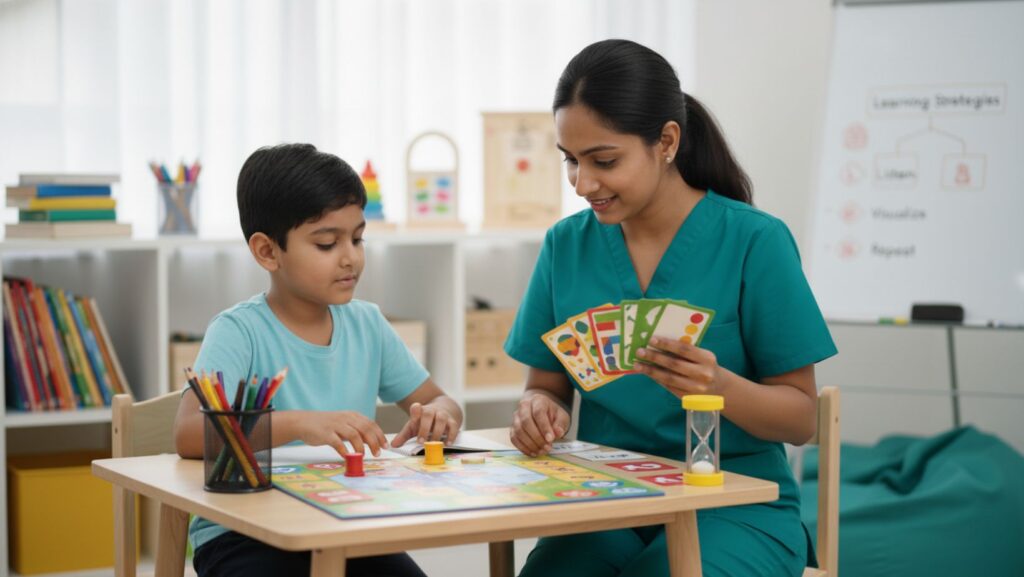
Critical for children with ADHD or slow processing:
➡️ Sustained attention training
➡️ Working memory improvement
➡️ Instruction following
➡️ Task sequencing
➡️ Study strategies
➡️ Exam readiness
We help children:
➡️ Plan tasks
➡️ Organise schoolwork
➡️ Manage time
➡️ Complete assignments independently
➡️ Reduce dependency on parents
These skills are essential for long-term academic success.


Education therapy supports:
➡️ Sitting tolerance
➡️ Classroom participation
➡️ Listening skills
➡️ Reduced avoidance behavior
➡️ Improved confidence
Children undergoing our sensory therapy program commonly show improvement in:
We evaluate:
Academic skills, Attention & memory, Learning speed, Comprehension level, Behavioral impact on learning
Clear, measurable goals are set for: Reading, Writing, Maths, Attention, Academic independence
Sessions are conducted one-on-one or in small groups based on need.
Parents receive learning strategies and structured home activities.
Monthly reviews ensure measurable improvement and plan updates.
With consistent education therapy, children show improvements in:
➡️ Reading fluency & comprehension
➡️ Writing clarity
➡️ Math understanding
➡️ Attention & focus
➡️ Learning speed
➡️ Homework independence
➡️ Academic confidence
➡️ Classroom participation
Progress is practical, visible, and measurable.
➡️ Certified education therapists
➡️ Individualized learning plans
➡️ Multidisciplinary support
➡️ Child-friendly environment
➡️ Evidence-based approach
➡️ Transparent progress tracking
➡️ Strong parent involvement
This is education therapy that actually works.
Early intervention prevents academic failure and builds confidence.
📞 Book an assessment at Nivera Child Developmental Center, Trivandrum
Expert Therapists | Personalized Learning Plans | Proven Results
Education therapy is a structured intervention that helps children improve learning skills such as reading, writing, maths, attention, memory, and academic organization. It focuses on how a child learns, not just what is taught.
Tutoring repeats school lessons. Education therapy identifies and fixes the underlying learning difficulties—such as poor attention, slow processing, weak comprehension, or memory issues—so the child can learn independently.
Children who struggle with academics, attention, comprehension, homework completion, or confidence in learning benefit from education therapy. It is also helpful for children with ADHD, autism, learning disabilities, or developmental delays.
Education therapy focuses on reading, writing, spelling, mathematics, attention, memory, executive functioning, comprehension, study skills, and academic independence.
Yes. Education therapy improves focus, task completion, organization, working memory, and study strategies, which are common challenges in children with ADHD.
Yes. Education therapy supports structured learning, comprehension, communication, task sequencing, and academic behavior for children on the autism spectrum.
Most children attend 2–4 sessions per week, depending on their learning needs and goals. The frequency is decided after a detailed assessment.
Many children show improvements in attention, confidence, and learning skills within 6–8 weeks. Academic progress continues steadily with consistent sessions.
Yes. Each child receives a customized Individual Education Plan (IEP) based on assessment findings, strengths, and areas needing support.
Yes. Education therapy uses multisensory and phonics-based strategies to improve reading fluency, comprehension, spelling, handwriting, and written expression.
Yes. We focus on concept clarity, number sense, logical reasoning, and problem-solving rather than rote memorization.
Yes. Parents receive guidance, home activities, and strategies to support learning outside therapy sessions.
No. It is also beneficial for slow learners, children falling behind in school, or those struggling academically without a formal diagnosis.
Yes. Children show better homework completion, classroom participation, exam readiness, and academic confidence.
You can contact Nivera Child Developmental Center in Trivandrum to book an initial learning assessment. Based on the assessment, a personalized education therapy plan will be created.
Nivera Child Development Center, Trivandrum – providing expert care, therapies, and support to help every child grow, learn, and thrive.
